Blog Archives
Quick Tip on Train Travel in Bavaria
To save some money traveling by train in Bavaria, get a Bayern-Ticket. Get a few folks together and take advantage of the 29€ ride all day pass – good up to 5 travelers. Don’t know 4 other people? That’s fine just hang out by the ticket machines and ask folks. Seriously! Regular fare is 30€ or so, this way it’s only 6€. that’s for the local not the express trains. Express is about 50€ and saves only 30 minutes or so from Nürnberg to München. But for 10% of the cost it’s definitely worth it!

Meandering in NOLA
I found myself in New Orleans over the weekend. I’ve been here twice before, but neither time was to see the city; each time was to be a part of a more generic tourist horde.
Once was in college when Mardi Gras coincided with Spring Break. A bunch of friends got together and all pitched in some sum of money that was almost a night’s stay. Then we packed ourselves – 6 if memory serves – into the biggest car we had drive the 10 hours from Atlanta. Space was limited so wardrobe was too. That wasn’t a bad thing since, given the general level of mess everywhere on Bourbon Street (the main Mardi Gras tourist party area), whatever you wore was sure to get ruined. If you’ve been you know what I’m talking about. I didn’t end up seeing much of anything outside of that debaucherous corridor.
The second time I was here was for a bachelor party and the results were similar. Lots of booze, little sleep and not much scenery. Ended up missing my flight, camping out at the airport all day waiting on a standby seat, then staying the night to take the first flight out Monday morning. Strike two for me here.
This time though the reason for the trip was not revelry, so I stood a good chance at getting to take in the culture.
Walked down Magazine Street, a quiet shopping street. Magazine has mostly smaller shops, unlike so many other similar streets in other cities like Boulder or New York. But then those places don’t have a Bourbon Street.
Grabbed a beer at The Bulldog which boasts over 80 beers on tap. They also have a beer tap fountain on the patio. 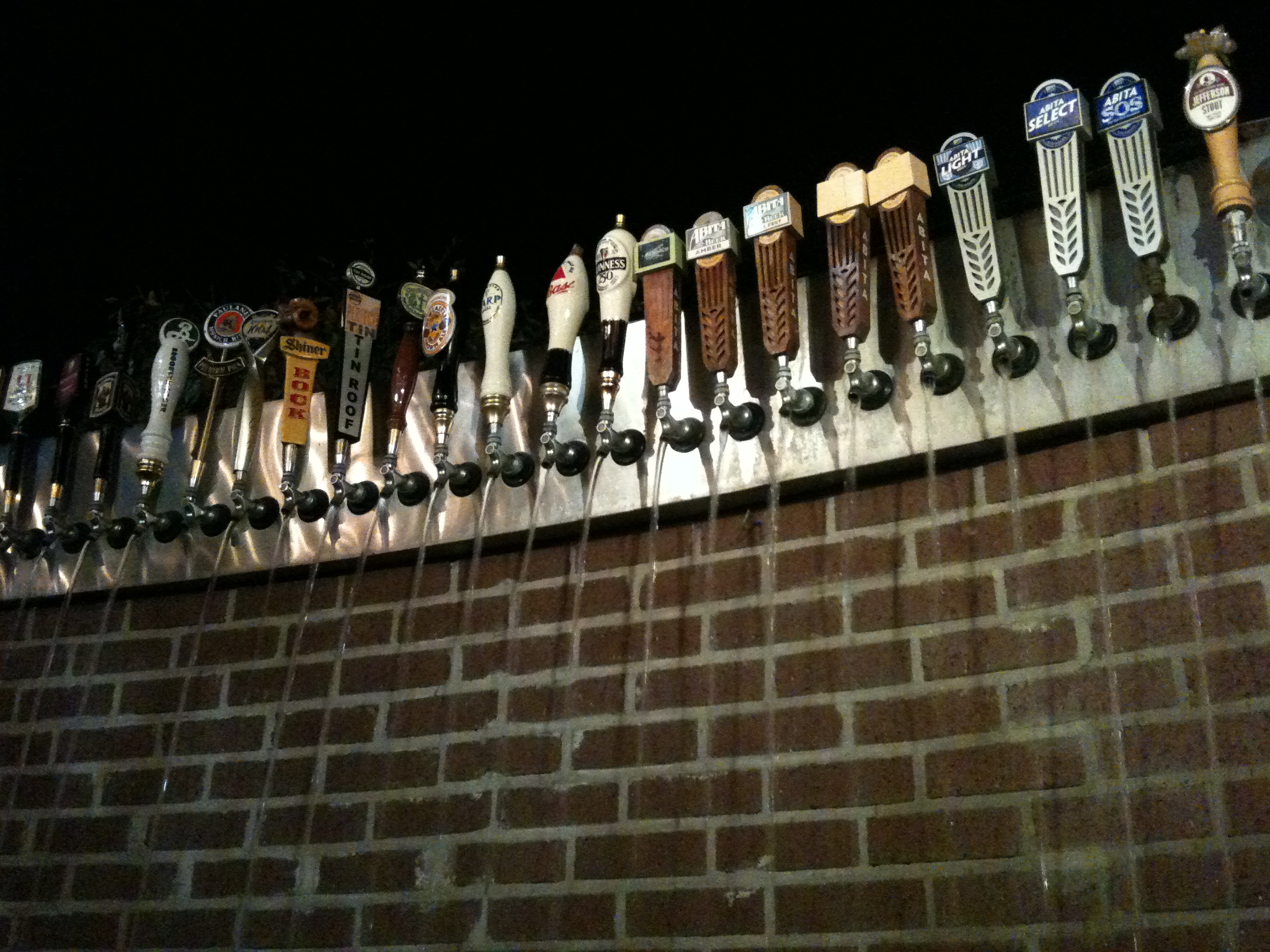
Even though I was stuffed I am a sucker for a good burrito. That’s how I found myself in Juan’s Flying Burrito. Great place, fantastic burrito.
Found a place called the Circle Bar. Lots of people standing outside a house, amongst buildings where no house should be. Accidentally happened into front row seats for the concert about to start.
That’s how I met Lips. She’s a singer in a band (Lips and the Trips) and invited me to come see her perform the next night at a coffee shop. So I said why not. They were good and got me into yet a different part of the town – equally as nice and quiet.
 Then I headed down Frenchmen Street. That’s an area of town where live music is squeezed out of every corner and cubby and mixes together like a cajun dish or creole language. Went to a place called dba on a recommendation and it was fantastic. Good jazzy blues band played and some great beers on tap and in bottle, including the fantastic Racer 5 from Bear Republic.
All in all it was a great trip. I did make the requisite migration to Bourbon Street, but unlike a decade ago I found it didn’t interest me at all. It seemed just a smelly alley compared to the rest of the city. I know many people for whom New Orleans is their favorite city. And it’s growing on me too. It may not be San Francisco or Lasa, but it feels comfortable to me now. Just one good trip was all it took to wash away the iniquity of past lives there. So I’m looking forward to the next time I get the chance to head there.
Review – Smile When You’re Lying: Confessions of a Rogue Travel Writer


- Latin American police “corruption” is just a more efficient way of accomplishing the same thing. Cut out the lawyers, judges, court clerks, paperwork and everything and just pay the cop a nominal fee. Typically travelers will be confronted for doing something like speeding or not having the right documentation. The officer will, in a roundabout way, imply that there’s a small fee that can be paid on the spot which will allow the traveler to continue. And the American traveler will become indignant. You got caught doing something you knew you weren’t supposed to; pay the man. It’s a small price to pay to be back on your way and you can feel good that you helped the local constabulary put food on their table.
- Most of the time the Americans are the most polite travelers. I’ve met more jackasses among the supposedly more civilized Europeans than anyone else. And that doesn’t count the numerous other of the English-speaking countries’ citizens that usually lead the pack in being idiots (I’m looking at you, New Zealand and South Africa). Note that this doesn’t apply to Americans in Tijuana and Cancun. I once watched a friend of mine scream in a hotel that he was the only reason anyone there had a job and he should be treated like a king. This despite the staff politely assigning him another room after he smashed his window and the glass fell into a playground. Even after his tirade they didn’t kick him out, though I was about to.
- Travel is good for the soul and coming home is usually a bigger culture shock. After being somewhere else for a while you really start to see your homeland from an outsider’s eyes. For better or worse.
- Horror stories are better than pleasant ones. There’s nothing quite as funny as hearing the near-slapstick comedy stories of misunderstanding and woe on the road. There’s nothing so compelling as hearing about a harrowing escape while getting shaken down by the Russian mafia. And there’s nothing more heartwarming than hearing of a travel angel who saved your bacon each time.
- Things are never as bad or as dangerous as you hear. Yes, there’s corruption and danger and squalor out there in the rest of the world. But there is wherever you’re from, too. You just don’t think of it that way. Some of the happiest and most generous people live on less than a dollar a day. Some of the friendliest are in places people tell you are too dangerous. Some of the most honest and helpful are in the places supposedly most corrupt. When someone says “don’t go there” I usually put it on my to-do list.
But there were a couple of topics I rant about that I didn’t see in the book. Though he came close to these topics, the difference is enough that I feel like I have room to expound my ideas without stepping on the author’s toes.
The first crackpot theory I didn’t read about is that the worst words you can learn in a foreign language are “Do you speak English”. If they can, they’ll understand you in English. If they can’t, they won’t. But worse, it more often than not gives them the idea that you probably speak their language passably and so they won’t take the bait. But if you just go up and start talking to them, asking whatever question you had to begin with, they’ll usually reply back well enough or point you to someone who can. It wasn’t trial-and-error of an American lout that taught me that, but by observation of many a fellow traveler – also foreign but never American – who bristle indigently if the English is not good enough or the reply not polite enough. One of the funniest conversations I can say I have witnessed, though it’s only really funny in hindsight, is a Korean yelling at a Russian militia officer in his precinct and implying that it had been his colleagues who had stolen her DSLR along with her travel itinerary across Eastern Europe and the Middle East; each butchering my native tongue more the angrier they got. And neither pausing to apologize for not speaking the other’s language or suggesting such a dumb thing.
The second harebrained idea left unaddressed by the book is that I can never respect an American abroad who pretend to be Canadian. I don’t begrudge the Canadians at all, I’ve had great times with many of them. Nor do I resent Americans who are sometimes ashamed of their “home and native land.” No, it’s that these people tend to simply want to hide in the citizenship of the Great White North because they find it tiring to stand up to Eurotrash bullies whose only view of Americans has come through sitcoms and stereotypes. What’s the point of traveling thousands of miles to simply swim downstream because it’s easier? Why not go hang out at the Gap at the corner of Haight and Ashbury and complain about the fascist capitalist pigs while downing another granola bar you pretend wasn’t made by a billion dollar conglomerate, sourced by organic corporate farming (not that I’m against corporations or corporate food – I happen to enjoy quite a lot of it – I’m just against the hypocrisy of the delusional pseudo-hippies who are exactly the kind who follow the Lonely Planet guides’ every recommendation and consider themselves better than those on a package tour even though the effect is the same…but I’m off topic). One of the biggest rewards of traveling is experiencing different viewpoints, perspectives and ways of life. And a part of the responsibility attached to that is to be a good ambassador of your homeland. I absolutely revel in helping a fellow traveler see my country through my eyes, and they usually come away from the experience with an increased respect for Americans and the country. Several of these folks had been sworn enemies of Americans and their bible-thumping, two-Bush-electing, Big-Mac-eating (a German in Australia once asked how Americans could survive with only one McDonald’s around, and it being on the other side of the city), science-hating, racist (I’ve never met so many racists living in the South all my life as I have in my limited travels through Europe and Asia) dimwitted Ugly American ways.
There’s a follow-up book called To Hellholes and Back: Bribes, Lies, and the Art of Extreme Tourism
Baltimore for Halloween
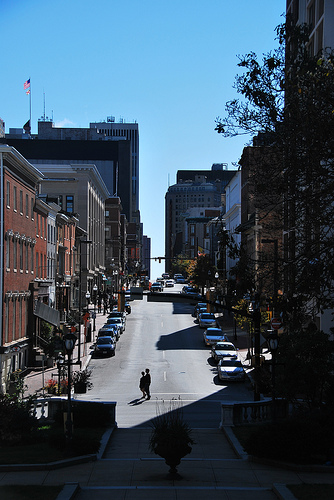 Flew into Baltimore for the weekend. I’d never been there before, but figured it’d be a good place to go for Halloween. The forecast earlier in the week was for sunny and mild temperatures. But by the time I arrived it’d been downgraded to cold and rainy, with a chance of flurries. Damn. Oh well, try to make the best of it. I took some notes and some photos and here they are.
Max’s Empanadas in Little Italy is a small lively Argentine joint. Funky music, funky paintings, photos from around the world, and of course Argentine wine. The empanada is a dish I traditionally associate with Mexico, but it makes sense that there would be a broader use of the term. Certainly the dish isn’t local to Latin America – its fried dumplings or gnocchi or pirogi in other parts of the world. Here at Max’s it’s delicious. It seems like a great neighborhood spot and a hidden gem down a side street.
Fell’s Point is an eclectic area. The main street is called Broadway and it is a broad way. Lined with bars and storefronts, it’s a nice place for a stroll. This is THE place to be on Halloween in Baltimore. All the revelers come out in costume to see and be seen. The uniqueness of each costume made identifying the people much easier. So their behavior was made more apparent as they’d hop in one door, out another (many bars seem to have two doors), in again, out again. Like ants into and out of a mound, or like an episode of Benny Hill.
I visited a couple of restaurants in this area and both were good. Lebanese Taverna had a good Halloween party, with proceeds to benefit the Edgar Allan Poe House – a charity dedicated to preserving the legacy of the famous Baltimoron…Baltimorean…Baltemorite…whatever. The food was good, as was the specialty Raven beer, from a local brewery also participating in the event. Obrycki’s Seafood is a great place to get crabs. It’s been popularized by many TV shows and articles on the Internet.
On Sundays, there’s a Farmer’s Market & Bazaar that looks to have some of everything. I particularly enjoyed the Mexican crepes.
Back to Nicaragua
Back in Nicaragua again. But a slightly different itinerary this time around. Spending a day or two on either side of the humanitarian work to see more of the country.
First stop was a town called Granada, east of the capital Managua and located on a volcanic lake where freshwater sharks play. I’d never heard of them either, apparently this is the only place they live. Swimming up the rivers like salmon. Interesting.
We caught a luxury taxi ride from the airport – meaning it had air conditioning – and were there about 45 minutes later. Stayed at a nice place called Hotel Patio del Malinche, a couple of blocks off the main square towards the lake.
Granada herself is much more touristy and appropriate for expat living than is Chinandega. But yet still much less touristy than most places I’ve been. There is a central area where tourists comply with the obligatory invitation of any centralized market to go see what life is about in the local area. Booths targeting tourists don’t quite clog the square but they impede the way with large tents, tables and other accoutrements.
But it all seems a bit staged. Several identical vendors sell things but to no crowds in the off season. No fewer than three ice cream bike vendors pedal over each others’ tracks in concentric circles. It’s like walking into a fair where all the rides are going but nobody is on them. A little off putting.
But when the town realizes that it’s Saturday night and the tourist crowds (such that they are) flock to the many restaurants and bars catering to their tastes, the streets and local establishments shine. Side streets close to the tourist areas even have vibrant local venues. And you’re as likely to run into a group of college kids as not. Tourists have their havens but the places where they’re not really typify this town.
So when the taxi came this morning to haul us off I left with a feeling that I hadn’t really seen the town. I certainly hadn’t done the many local activities available like kayaking and ziplining, but I had also missed out on the real treats like the lake itself and the real life functioning of the city. It’s not a place to spend a lot of a limited amount of time but as a couple of day layover you could do worse.
Back in Chinandega now and glad it’s off the beaten path. True, there’s not a luxury accommodation like we had in Granada but then again I’m not tarred as a tourist. The local places smile at the novelty rather than smirk at the gouging. Happy to be here.
Edinburgh and a Short Scotish Meander
 I headed to Edinburgh on a business trip. In town for a week. It tends to rain a lot in Scotland. Not that it rains hard, just often. Little sprinkles and showers all the time. Just enough to get you damp then dry out in between. It’s a bit worrying the first couple of times but after that you just zip up your jacket and keep going. There’s quite a lot of wind, especially at the top of the hills and ridges.
My first experience was my chatty cabby at 7am. Good folks to know, cabbies who grew up in the area they drive in. Asking about places to see inside the city here’s the list I wrote down. Mind you, this was early in the morning, accents and unfamiliar place names, so I may not have gotten these quite right.
- South Queensberry bridges over firth.
- Feaheys College. Really nice building. Tony Blair went to school there.
- Westcoates. Donaldson’s school for the deaf. Impressive building. Copper roofs.
- Craig Miller castle. Mary Queen of Scots lived there. Little France is down around there where her French retinue lived.
Here are a few recommendations of my own.
- North Berwick is a sleepy little seaside village and a suburb of Edinburgh. There’s a volcanic island shooting up out of the Firth of Forth called Seal Rock. You can get a boat out to the island and back and spend some time out there. There’s an old cemetery there dating back from the late 18th century.
- If you climb up Arthur’s seat take a jacket even if it’s borderline. Never know when a storm will come in and throw wind and rain at you with no shelter in sight. Nice hike. The whole Hollyrood park area is a great for hiking.
- In the Pentland hills is a neat little prehistoric spot. There is a low hill that was some sort of stone or bronze age fortification with a moat around it. An underground path led to a granary. Being underground kept it safe from the elements, cool enough to protect it and let the locals keep out the vermin.
My boss and I took a day trip down to the Border Abbeys. The 12th century Monks at the Abbey of Melrose were sheepherders – at one point the largest sheep farm in Europe. Also metallurgists. They prized self reliance so wanted to make everything themselves. Wanted to never come into contact with the outside world and they were a silent order. But established a trading empire.
So they established a tradition of lay-brothers – people not high born enough to become monks who they schooled in the Cistercian traditions and ways so they’d be less tainted by the outside world. These lay brothers then built up the trade with France and Flanders and made the monks quite wealthy. Also prayed for the wealthy and so were rewarded. Eventually became very wealthy and became much less austere.
They were vegetarian because they felt that eating meat led to carnal thoughts. But the ill or infirmed were allowed meat since they were too weak for such thoughts and put of Satan’s grasp.
In the 14th century it was common to bury different parts in different places. So you could be buried at your birthplace, by your wife and other places you liked. It’s said that Robert the Bruce’s heart may be buried here.
While we were at the abbey there was a wedding. Good Scottish bagpiping. and a grand time was had by all.
Then we went to the island of Lindisfarne, famous for being the first city sacked in 793 by a band of seafaring Norsemen, ushering in the Age of the Vikings. It’s an interesting place since the tide completely covers the road twice a day. So you have to be careful when you drive out there that you’ve got time enough to come back. There’s ruins of the priory there, a nice castle out on a hill and a ratio of B&Bs to residents roughly 1:1.
Dining and Drinking
- Try the restaurant Made in Italy – fantastic dressing came with the side salad. Like a creamy balsamic vinaigrette but not like any I’ve had.
- Sandy’s Bell has artists cone and play traditional Scottish music. Usually not planned, just an open mic affair. Artists meet and play then swap off with each other. Listed in tourist literature but still filled with locals.
- There’s a little Brazilian kiosk called Tupiniquium that does smoothies, juices, crepes and other nice things. The guy who runs it will let you know what’s fresh today and steer you toward something tasty. Located just at Lauriston Place.
- In the shadow of Edinburgh Castle, Inside the Scotch Whisky Museum is a restaurant called Amber. Quite a great spot for dinner. Reasonable prices, excellent food – I had an absolutely singular dish of peat smoke haddock topped with a soft boiled egg in milk – a handful of good Scottish beers and of course a book full of whiskies to try, which are similarly excellent and inexpensive. Try the Hollyrood Pale Ale. It’s excellent.
- Swing in to the Mussel Inn and hopefully you can get a table to try their excellent mussels. It’s a local place a block or two off the main street and is often crowded.
- There’s an excellent French restaurant called Pierre Victoire. When my boss and I got there they immediately trotted out a delicious mackerel appetizer. If you know my boss you know he loves mackerel so that absolutely hit the spot.
- There’s a bar down a bit southwest of the main street called Canny Mans. As a rule they don’t allow shorts, t-shirts, backpacks or credit cards. They recommend that you “dress casual but smart”. It’s worth the hassle to see the 80 years of decor and vestibules.
- The Rat Pack piano bar stays open late and is a good time even if you’re not into piano bars. They play all kinds of music, not just that from the mid-60s. They do Elton John, Billy Joel and others.
- As far as places to drink scotch malt whisky go, there’s no better than the Scotch Malt Whisky Society. It’s a membership-only establishment so you’ll need to know somebody to get in or pony up pretty heavy.
- There’s a little town on the way from Berwick (pronounced burrick) Upon Tweed to Dunkirk I stopped into for dinner. There is a restaurant called the Anchor Inn that I ate at. The kitchen officially shuts at 9 but they opened it back up so I could get dinner. Very nice! I had the walnut and mushroom roast. No meat in it. Was very good! Also the haddock is very good. Pan fried rather than deep fried.
Meanderings In Brazil
I went to Brazil and didn’t tell you for too long. Sorry, Internets. Here’s a short catchup.
Flew into Sao Paolo to do a presentation for work. Getting a Visa to go was an expensive hassle but got it done by shipping my passport and a pile of cash to some dude in New York who carried it to the consulate the next day, waited around to get it approved and added, then shipped it back. I’m not sure how he got it done, but nobody at the immigrations office seemed to have any problems with it so I was good to go.
Met up with a colleague, then went and got checked into the hotel. He is fluent in Spanish and passable in Brazilian Portuguese so we got around OK. Next day we went into the local office and met a bunch more folks. Ended going out with them for dinner that night and a couple of drinks after. We went by a very interesting place called Hotel Unique, which is shaped like a giant wooden boat. Then we went to a rooftop bar from which we could see a large portion of the skyscrapers in the city of 20+ million.
After the work event I headed down to the small city of Porto Alegre, in the state of Rio Grande do Sul. Another colleague lives there and I met up with him. He had a day of activities planned, including a tour around the corporate and university campus, lunch in the eclectic cafeteria and hanging out with friends. Over the weekend he invited me and a lot of friends over to his place to do a traditional Brazilian barbecue (barbacoa). Their way is different because they set the meat far away from the fire and do a slow roast. They use wood, rather than charcoal, so the meat takes on a smokier flavor too. It was absolutely delicious!

Porto Alegre, POA to those who fly in, is a great little city. About 3 million people so not really a metropolis. Rolling hills for a backdrop and gaucho culture similar to that of Argentina. Lots of beef. Churrascorias and things. Some slow roast the meat for a dozen hours or more so it’s very tender and delicious. No sauce or rubs except a sprinkling of salt so it’s just the flavor of the meat. There’s a really fantastic little place called Costela no Rolete you should ask about if you go! There are some hills overlooking the city and they give a magnificent view of the city, river, rolling hills and plains off in the distance. Very nice city. Great weather the whole time I was there.
Some other notes on Brazil:
- A sweetened, carbonated guarana juice is a popular drink here. It’s easy to see why – tasty and refreshing. There seem to be several regional favorites with slightly different flavors.
- In Rio Grande do Sul they’ve got a traditional drink that’s like a chilled yerba mate. It’s pretty tasty.
- Everything is really expensive. A value meal from McDonalds is over $10, and drinks range from $7-8 for a cheap beer to $30 for a draft in a nice bar. Outrageous!
- Lots of local beers. Fine German and Italian beer tradition. One of the best I had was Bohemia. Classic pilsner taste – very clean. I’m not a big pilsner fan but this one was good and great on a hot day at a cookout.
- At the airport the security line goes very fast. Mainly because a strip search isn’t involved but also because they’re well staffed. Don’t have to take off your shoes. Don’t have to remove your laptop. Don’t have to remove liquids. I don’t know what the rules are for size etc. because I didn’t run into any of the limits. And nobody checks your documents when getting on the plane.
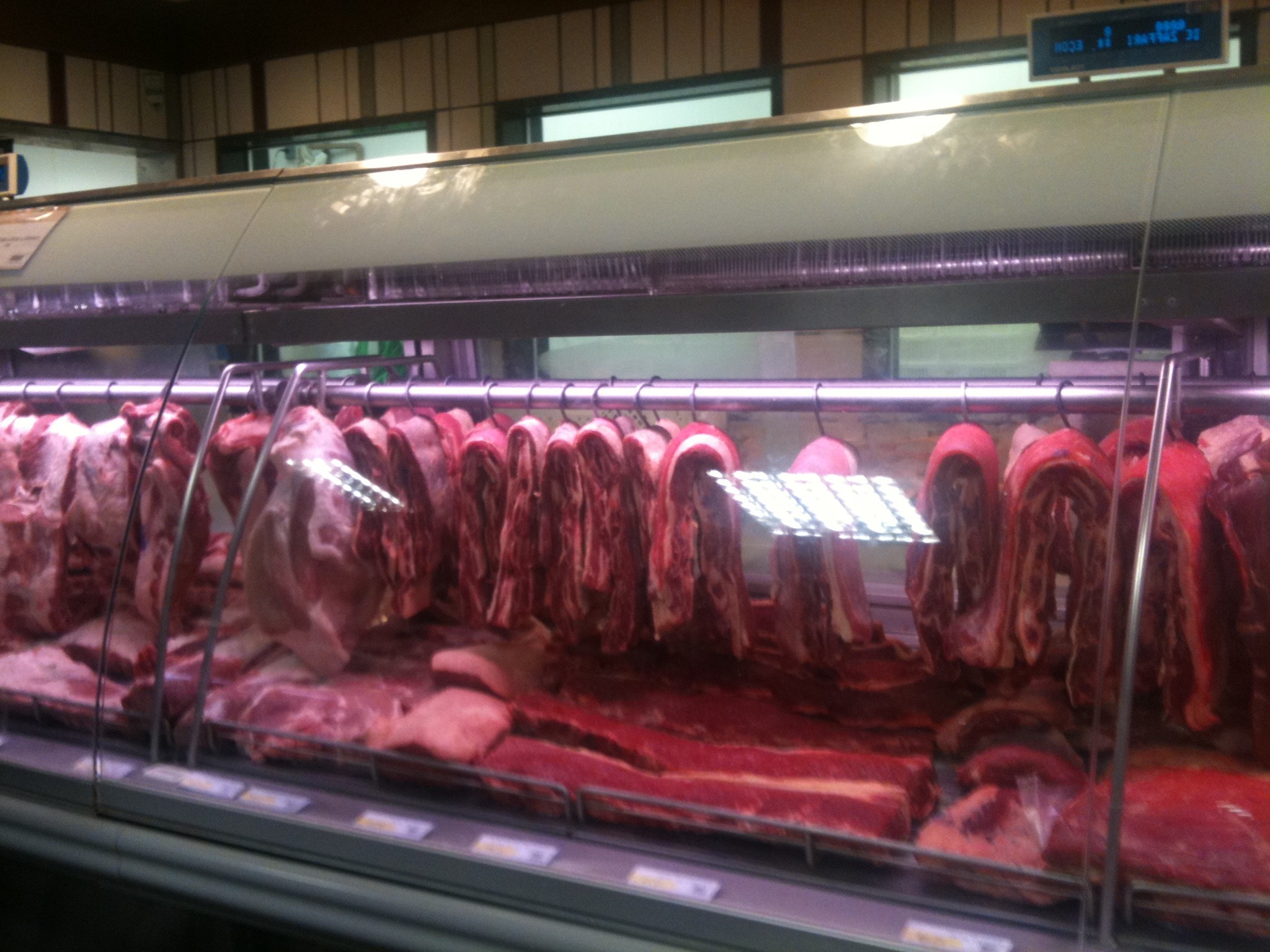
- The grocery store has a whole aisle of meat. It’s fascinating.

Tracking Your Trip With Your Phone
For a while I’ve been trying to find a device that will let me track myself wherever I go to map out my routes. Then when I got an iPhone I figured there’d be an app for that. Google Latitude came close, but no cigar. But I’ve found a great one!
Turns out, my iPhone tracks what cell towers I’m connected to and stores that data on the phone for a year. Well that’s not going to give you GPS-quality coordinates, but it’s certainly enough for me to show a trip I took and map things out roughly. There’s even an app for that (Mac only for now). Here’s where I’ve been in the last year.
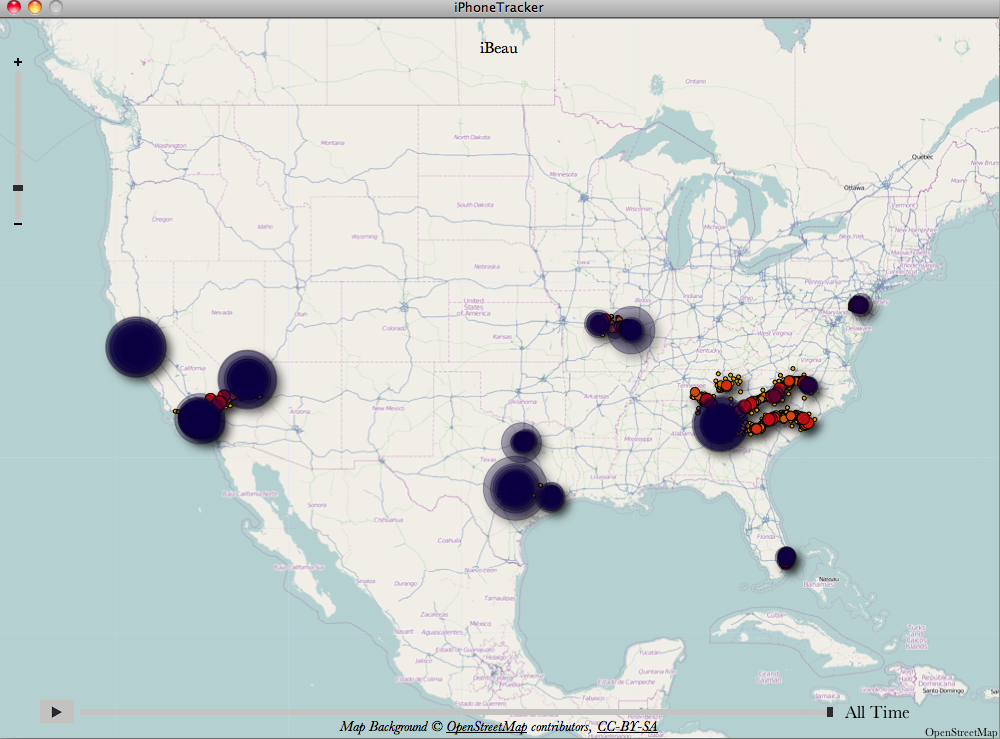
There’s apparently a similar cell tower log file on Android-based phones too. This information has apparently been known for a while, but was just brought up and publicized recently as a security or privacy risk. But that risk is pretty low, considering that someone would have to already have your phone or computer to get the information. And if the data helps you do something positive, then it’s a pretty cool feature. I’d love to see Apple build out a service or piece of software that would accentuate this!
Austin Texas – The Culinary Experience
There is quite a lot of good food in Austin. There’s also some not so good. I ate at some of both while visiting.
Heard about a great breakfast spot called Kerbey Lane Cafe. So I headed over and squeezed into a parking spot – it was crowded – and went on in. Got a spot at the bar right away (one of the benefits of traveling and eating alone is you usually get a seat quickly). The bartender was a frenzy of activity. Sunday morning here, as most places, means hair of the dog in the form of mimosas and bloody maries. The guy must have made a hundred of these while I was seated. The bartender never had to pause as he juggled OJ, vodka, coffee, food, and all the other myriad tasks he had to do. Watching him work was worth the price of admission alone. Great food, world class service, inexpensive and very highly recommended.
If you’re out at night on 6th street, it’s worth it to sample some of the street food. That’s one of my favorite styles anywhere and it’s gratifying to see it here where it lacks in so many other American cities. Three patterns stand out among the street food of Austin: pizza, sausage and food trucks. The first two are self-explanatory. And so is the third, really. It’s a pretty simple formula – get an old truck, van, camper, bus or whatever you can find, put a kitchen in it and hang out a sign. They’re all over. Unfortunately the one run-in I had wasn’t good. But then again I went against my better judgement and got some fake buffalo wings. Some kind of fake soy-based chicken-like substance deep fried and tossed in hot sauce. The sauce was good and they were cooked well, but the imposter meat substitute was like juicy sawdust. Steer clear of that abomination and you should be good.
I have to say, I’ve never understood the Texican fascination with barbecued beef brisket. I’ve yet to have any that compared favorably to a better than average pork BBQ. I just don’t get the fascination with it. You take perfectly good steak and don’t cook it like a steak? How is that supposed to be awesome? Maybe it’s an acquired taste to ruin something great, like when the X-Files kept filling their shows with the conspiracy theory stuff. It was just misleading and dull. Kind of like brisket.
But putting my personal feelings aside I tried two of the finer establishments. In beef barbecue that means one was in the middle of a cattle field and the other was at a gas station. No really, that’s not a snarky comment these were the two most highly recommended places in town. The first place I won’t mention, but when you ask around town it’ll be the first place mentioned. I stopped by the one up in Round Rock, just north of the city. My appetizers were the waft of manure that would occasionally waft in and the feast of flesh my eyes got looking at the waitresses and clientele. Both reminded me that just outside Austin, Texas lurks. The ribs were alright but weren’t anything to write about (despite the current activity I’m engaged in). The pinto beans were bland. The cole slaw was essentially shredded cabbage in vinegar. The potatoes au gratin were cold and that’s the best thing I could say about them.
The second place I visited is called Rudy’s Country Store and BBQ. Here too I visited the Round Rock location – where they also serve as a Shell station and convenience store. The highlight was when they asked if I’d eaten there before. I said no and so was pronounced a Rudy’s virgin, entitled to a tasting of their various meats and a walkthrough of the menu and ordering process. It proceeded well and I got to sample some food. I chose my meat – the moist, rather than the lean, cut of brisket, a couple of sides and a Mexican Coke with real sugar. The food was fairly good – the sides were better than the first place and the brisket was tasty. But still after a few bites I found myself wishing they’d made a burger out of it instead.
A couple of places on 6th street I had good luck with I’ve already mentioned when discussing Austin’s nightlife: Jackalope and Casino El Camino. Jackalope has great quesadillas. Casino El Camino has pretty good burgers. Each has great atmosphere.
There’s a place south of 6th where I had a great breakfast, called Crepe Cafe. Run by an authentic Frenchman (in Texas!) who takes pride in his work. Good coffee there too. And lots of French kitch inside. His wife runs an antique store in town, so I’m told.
 meanderingwoods