Blog Archives
A Tale of Two Brandy Factories
Armenia is famous for it’s brandy, which rivals some of the best in the world. The tradition of the two main brandy makers in Armenia goes back only to 1887, but they have a rich reputation. In 1902 an unlabeled bottle won first place at a brandy contest held in France, and was reportedly the only non-French drink ever awarded the right to call itself Cognac (though later legislation forbade this). Churchill favored the 50% Dvin style over all other brandies. And the Kremlin Award brand is the one used in official Russian state ceremonies.
Brandy is a distilled spirit made from fruits. In this case, nearly all of the Armenian brandy is made from grapes – a fruit which grows in great abundance here. Glass pipes transport the cognac between barrels. As cognac ages it is moved to older barrels, enriching the flavor. Once it has matured sufficiently, the liquid from each barrel is tasted, blended with others and mixed with water until it reaches the desired flavor and strength. Then the brandy is aged for a few months to allow the different flavors to marry with each other. The age marked on the bottle is the average age of each spirit which goes into the final blend. French Cognac is also made this way, but has the added distinction of having been born in the Cognac region of France and so can apply the trademarked label to its bottles. French Cognac also marks the bottles with a rating system which describes the youngest spirit in the blend, rather than the average. When drinking, you should always use a brandy snifter. The proper amount to have is just enough so that when you tip the glass on its side, it comes to the edge, but does not spill.
Today Armenia’s two main brandy factories sit across the road from each other. Having once been a part of the same company, their stories are intertwined and often confusing. But each factory site tour is interesting in its own right. So for you, dear reader, I have gone to the trouble of examining both and reporting back.
Common History
In the 16th century, Erevan Fortress was built just outside what is modern day Yerevan. In 1887, the fortress was turned into a winery. In 1902 the first brandy was bottled and won the aforementioned first prize. In 1920 the factory was one of the first to be nationalized by the state, and during this state-run period vodka production was begun as well. In 1945, Churchill enjoyed the spirit at the Yalta summit and Stalin sent him a case every month for the rest of his life. It’s said that when the flavor changed, he complained to Stalin who had to quickly retrieve the master distiller from Siberia where he had been recently exiled. In 1953 a new factory was built and brandy production moved to this new facility. In 1998 the brandy factory was sold to Pernod Ricard (rumor has it for a price less than the value of its assets) and at some point the original factory began making and selling brandy under a different name.
This split is what makes the history so murky. The current day location of this new factory houses the Yerevan Brandy Company (commonly called ArArAt), whereas the original location in the fortress is called the Yerevan Wine Company (commonly known as Noy). Since both companies have a similar lineage, both claim it proudly but ignore the elephant across the street, as it were. So it’s a bit hard to piece together the history into one single story. Each factory claims to be THE original brandy lineage and it seems each has a pretty good claim. So the real question then is how were the tours and how is the brandy?

The original Erevan fortress has been restored several times and is now in fantastic shape. There’s a legend about an old bell that one of the previous owners, Shustov, would ring after each batch of wine had been made. A replica has been incorporated into the building. The first stop on the tour is a large room with many bottled brandies in glass cases, along with some of the awards. There are photos all around of the new owner doing things and of the dignitaries who have visited. It seems very self-important and a bit pompous. There’s a large oil painting of the owner that looks over the room like in some creepy Scoobie Doo episode where the ghost is looking through the eyes of the painting. We were asked to wait here for 10 minutes while another group passed through and our guide went off to chat with her friends.
After being alternately rushed and asked to wait through a few more places telling the story of the place, we were taken down to the cellars. We had a special treat in front of us – the opportunity to taste a 1924 Madiera wine! It was very nice and smooth, and you could really taste the aging. I’m not sure I’ll ever top that again for sheer age of a beverage. It was impressive. They have enough old wine in the barrels down there to last visitors about a hundred years, they claim, since they don’t sell the wine.
Next we saw a couple of old caverns. Apparently they were dug by prisoners at some point, and were allegedly to bring in grapes from the surrounding areas to keep them cool. But that explanation didn’t make a lot of sense, because the grapes would have to come many miles before hitting a cavern. Instead I suspect that they were dug as escape and supply routes in the event that the fort were ever sieged. More recently they may have been made for more nefarious purposes, as one leads to the US Embassy.
Finally to the tasting. We were seated at a table with some difficulty – there were more people than places and this baffled our guide who spent a few minutes looking at the table, the people and you could almost see the gears turning. So with some difficulty the non-drinkers were asked to sit at another table (purgatory) while the rest of us enjoyed water, juice, fresh fruit and chocolate. Other than the logistics the tasting was quite nice and an Iranian group next to us took great pains to try to communicate with us and emphasize that they like America a lot.
This tour focuses on everything but the brandy. The factory, owners, old wines, etc. We were continually told to stop and wait while other groups either caught up or were given priority. And we were rushed through the brandy tasting too quickly to enjoy it. Overall I give the tour a D, the building and grounds a B+ and tasting an A+. If you’re planning to go, I would recommend you call ahead and reserve an English guide: +374 10 547048
Yerevan Brandy Factory (Ararat)

This is the factory originally built in 1953. The tour here begins and ends in the gift shop. In comparison with the Noy tour, this one focuses much more on the making of brandy. And of course highlights the common history and modern differences. For instance, it’s at this distillery that visiting heads of state are given their own barrels of brandy to age and wait for the proper time to be bottled, as a present for the dignitary.
The guide went to a great length to make sure we all understood what she was trying to communicate. Both tour guides had obviously received training from a script, but the script here is much better and the guide seemed a lot happier to tell us about things. Always smiling and chaperoning us around in a well choreographed way.
The guide also told us many of the Armenian legends involving wine or brandy. One I recall was that tiny devils dance on the top of brandy glasses. When you clink glasses some fall away but what fall in your glass are what make you drunk. It’s not your fault nor that of the brandy, it’s just the devils. Another saying is that you should only ever have three glasses of brandy: “The first glass is only to slake thirst. Second is just joy. Third is happiness. Fourth is craziness.”
I would give the tour here an A, the building and grounds a B- and the tasting a B. Call ahead for reservations here too: +374 10 540 000 You can likely take care of both tours on the same day.
Who Are the People In Your Neighborhood?
You can run into lots of interesting people in such a small city that’s so important to the country. For example, there’s a guy who keeps his girlfriend company at the flower shop just outside my door. He’s been to Atlanta once, he said. In 1996. As an Olympic boxer. The guy still retains his size and muscle, looking imposing standing around. I always make an effort to say hello and I hope he thinks kindly of me, I’d hate to think it was the other way.
The past week the apartment above mine here has been rocking. Music plays starting in the morning around 8am and continues until well after midnight. And occasionally this is accompanied by loud thumping. What’s going on up there? Another interesting neighbor I suppose.
Now, this isn’t the first time I’ve heard music coming from above. Usually there are faint piano sounds. Sometimes these are really basic, like someone practicing scales, and sometimes it’s more like someone rehearsing a piece. It’s always very quiet and I have to strain to hear it. Occasionally there is recorded music that sounds like it’s Arabic or Persian – it’s hard for me to tell.
But starting about a week ago activity increased. The music was louder and more frequent, often going the whole day and late into the night. And the aforementioned thumping started up. I’m not an expert in the region’s music, but it sounded like the same song over and over again. In between playings I’d sometimes hear people talking.
One night the music and thumping was especially loud. Dishes started rattling from all the thumping and it sounded like the ceiling was going to collapse. It was like living below an earthquake. So I went upstairs to see what was up.
I banged on the door trying to overshadow the music. It must have worked because the music stopped, the locks turned and the door swung open. I’m not sure what I was expecting to see behind it, but the sight surprised me.
When I opened the door I was greeted by something much larger and more intimidating than the boxer outside. A guy stepped out, about 6’5″ tall and with a lazy eye looking down at me, his mouth smiling. His shirt off, sweaty, out of breath and very muscular, it was a bit alarming, despite the big smile on his face. I don’t think I physically jumped back but in my mind I did.
I used my diplomatic tools to throw on a smile and speak first. “Do you speak English?”
“Hello. Hello. No English.” He reached out his large hand in a gesture of friendship to shake my hand. I took it.
Motioning to the ground with my other hand open and facing downward I said “It’s very loud.” Hopeful that I’d made my point, and relieved I’d managed to get to this point without physical harm I was bolstered a bit.
“Sorry. Sorry.” He offered his hand again, nodding, panting and still smiling. “Sorry.”
Nothing left to discuss at the moment, I bid him goodbye. He slipped back inside and I went back downstairs. The music resumed, but had quieted noticeably and the thunder seemed more distant too. “What was going on?” I was left to wonder.
I’ve made a few conjectures, but have no real evidence for my theories. From what I can make out, I think the guy above is a performer. Probably some kind of a dancer. I think he must have been practicing for an upcoming performance. Probably with a group, judging by the traffic up and down the stairs. The music has since subsided, so I assume that he’s done his thing and is back to learning piano.
I hope to run into him at some point and try to talk with him. Seems like an interesting person and if I’m right, I’d love to see him perform or something. Or at least satisfy my deepening curiosity. Like I said, you can meet a lot of interesting people in a place like this, and this person is particularly interesting
Tips for Traveling with Technology
There was a Twitter conversation with Martin McKeay and Jerry Gamblin today talking about how geeks handle traveling with all our technology. Jerry suggested that Martin write a blog post, but I decided to beat him to the punch. 😉 This is part of an upcoming series of posts under the heading of Traveling Skills: The Art of Packing. In this post I’ll describe how and what I pack as a geek who travels with technology, as well as why.
My Travel Kit
These are the pieces of technology I pack with me wherever I go. Basically it’s my laptop, phone, camera, earbuds and a few cables and accessories.
- Apple Macbook Pro, with charger
- iPhone and USB cable
- 16 or 32 GB USB thumb drive
- 8 or 16 GB SD card (can double as a thumb drive in a pinch)
- SD to USB adapter
- Mophie Juice Pack and USB cable (iPhone battery/case)
- Dual USB wall adapter
- Mini dual USB car adapter
- 3-foot 3.5mm male to male audio cable (for car Aux input)
- Nikon prosumer DSLR with Nikkor 18-200mm VR lens (usually, but not always)
- Shure E2c (old mid-grade) earbuds with Comply Tx-100 foam tips
- Fenix E05 flashlight and one non-rechargeable alkaline AAA battery (these last way longer in storage than the rechargeable ones do)
- iPad (usually, but not always)
- Special mention: 3G Internet card (I used to travel with one of these and they’re great, but I don’t anymore)
I like to keep it simple. I keep all the cables and accessories in a clear ziplock bag so I never have to dig too far for things. The earbuds I usually keep in an exterior pocket of my bag or in my pants pocket.
My Support Kit
There are a variety of things I keep at home to support my travel kit. Most importantly are my chargers. The Nikon rarely runs out of juice, so I don’t have to worry about that. I also have extras of the cables and accessories, in case I lose one on the road I’m not without it on my next trip. I also have a battery charger and use rechargeables. They’re a bit more expensive, but worth it in the long run. All these things would be nice to have, but I really don’t use them often enough to justify bringing them along.
That brings me to my first philosophical rule of traveling with technology…
When in Doubt, Leave it Out
Equally as important as what I bring is what I don’t bring all the time. These are things that are either too heavy, or used too infrequently to justify bringing. If I know the job will call for something special then I’ll bring it, but normally I try to leave as much as possible at home.
Most people want to be prepared for whatever situation they may find themselves in. For geeks that means a lot of technical equipment. Phones, laptops, tablets, portable hard drives, external speakers, adapters, cables, chargers, batteries, antennas, and potentially dozens of other “can’t do without” items. And that doesn’t even include clothing, shoes, bags, books, and everything else. But all this stuff gets heavy and odds are you won’t end up using most of it. Here’s what I always ditch.
- Small portable speakers. I have a couple of great pairs, but I don’t use them often, they’re heavy and whenever I go to use them I find the batteries have already died.
- Extra laptop battery. I have replaced the battery once and it may be time to do it again. But I’d rather spend a little extra to have a fresh battery than lug an extra one around for months without needing it.
- Lots of camera lenses. I just use the one. It was more expensive than going with several lenses, but it’s a way more portable option. Plus, I treat my DSLR as a point-and-shoot anyway – I just want to whip it out and start snapping, not mess with lenses and such.
- Battery chargers. I only have one thing that requires a battery and I carry a spare. My DSLR has never run out of juice on me while I was on the road. Even on multi-week trips with hundreds of photos!
- Bigger flashlight or headlamp. I chose this one because it fits on my keychain, is bright and runs on a standard size battery. I don’t use it often and so it’s a compromise as compared with a headlamp or a big maglite or something.
- External hard drive. Do I really need access to 1TB of movies, songs, funny videos, or whatever? No. Do I need to backup everything over the course of a week? No. (See below for backing up on the road.) These things are bulky, require special cables, heavy and hardly ever get used.
- Extra laptop. Even when I was traveling for work and forbidden from doing personal things on my work laptop, I never brought a second one. I found that if my phone and iPad weren’t enough then it could usually wait until I got home. (See the next section for ways around that.)
Here’s a tip from my article on adopting a minimalist packing philosophy: Start packing with absolutely nothing, then ask. If the answer to 3/4 is “yes” then bring it. If not, leave it.
- Do I know it will be difficult, expensive or impossible to buy there?
- Am I positive that I’ll use it as much as I think?
- If I don’t bring it, will my trip be substantially worse?
- Do I use this every day at home?
Consolidate, Standardize and Compromise
Standardize on batteries and cables. Use interchangeable plugs and cables (for example, I have this dual USB adapter) to charge your devices, rather than a specialty one for each device. To the degree you can, get devices that run on standard size batteries so you can just buy new ones rather than having to lug a charger. That also helps in case your proprietary battery dies. And use the same size batteries across devices if you can so you can simplify things.
Ditch point-and-shoot cameras. Annie Leibovitz recommends the iPhone to a point-and-shoot. So do I. They’re way simpler and more portable, and you can share the photos right away. If you don’t like an iPhone, the one you’ve got will probably do just fine. And if not, I’m revoking your geek card. 😉 If you’re a serious photographer there may be no getting around a DSLR, but these days I often leave it at home unless I know I’ll be going somewhere photogenic.
Use the Cloud for everything you can. Yes, cloud security is an issue, but you can find ways around that. Crash Plan or Jungle Disk can replace your portable hard drive for incremental backups. Tablets and smart phones can replace a lot of what you’d need a full size computer for. Google Docs works fairly well for simple editing, and CloudOn is a full-blown Microsoft Office instance accessible through an app. If you ever find yourself seriously in need of a computer, the iPad has apps for that too. Consider LogMeIn to remotely connect back to your desktop at home. Or OnLive Desktop will provide you with a virtual Windows desktop.
International Tips
Get multiple power adapters, rather than one universal one. They’re usually smaller and easier to pack, plus you don’t have to carry them all if you’re not going everywhere. I bring 2 of these small European plug adapters and one of these multi-plug European plug adapters, as well as a 220/240v power converter (make sure you read up on how to use it) for devices that won’t handle that much voltage.
Your Tips
Have I missed something that you always take with you? Is there a good idea that you want to expand on? Let me know what you think.
Dan Pink’s Travel Tips
Dan Pink is an author and speaker. His books include Drive: The Surprising Truth About What Motivates Us, A Whole New Mind: Why Right Brainers Will Rule the Future (a great read on Audible), and The Adventures of Johnny Bunko: The Last Career Guide You’ll Ever Need. One of my favorite talks of all time is one he gave on motivation that was animated by RSAnimate, embedded below.
Dan has travel tips on his blog. Here they are, shamelessly stolen from boingboing where I found them.
Tip #1 — Never get sick again
Tip #2 — The magic of earplugs
Tip #3 — Four road food rules of thumb
Tip #4 — The rule of HAHU
Tip #5 — More hygiene!
Tip #6 — Staying connected
Tip #7 — Zipping through security lines
Tip #8 — One thing you should never do in a hotel room
Tip #9 — The secret(s) to beating jet lag
Tip #10 — The first thing you should buy
Tip #11 – The hidden benefits of Mickey D’s
Tip #12 – Never get sick again…again
Enjoy!
My Armenian Haircut
Today I subjected myself to my first haircut since arriving in Armenia. I survived and am actually pretty impressed with the craftsmanship and sense of purpose the barber showed. And I like the result, though it’s not my typical style.
I’ve been in need of a cut for quite some time now. As far as I can tell, the only place to get your hair cut is in a place marked Beauty Parlor or Beauty Salon. They serve both men and women – for men the going rate for places I’ve seen is 1,000-2,000 Dram, or about $3-5 USD. There are lots of these shops all over the city and there happens to be a place across the street from the apartment. That’s convenient. I went in and in broken English and broken Russian we mostly understood each other. Hair cut. Normalnaya? Da. Ok – Sit.
First wet and comb. Comb. Part. Comb. Part. Repart. The barber was meticulous, though I rarely my fingers through it much less a comb. He got the part straight as an incision. My hair lay open to his scalpel.
He started cutting by thinning first. Usually that’s saved for last. I was hoping he’d cut it shorter than it was at some point. Soon hair rained down Pools of hair form on the blue apron like dark rain on a tarp. After a while of this, it was indeed shorter. Just through attrition of the thinning shears eventually every hair was shortened to some degree.
Then he sets down the thinning shears and with a snap grabs clippers. Moves on to scissors again with a snap. A dozen or so changes, a dozen or so snaps. A couple of times he left it out.
 Always with the look of grim determination of a sculptor. Assessing, analyzing, adjusting. Every once in a while a look of surprise, then his lower lip would extend with a smidgen of pride. He labored over my hair with the intensity of one go has thrown himself into the task at hand. Every minute or so the comb would reappear to redefine the part and to straighten and push my uncooperative hair into shape.
The last step was a 15 minute comb solo, shaping, wetting, combing, blow drying, more wetting, a snip here and there for perfection. Finally, he proudly stepped back and with a pat on my shoulder silently announced that he was finished with me. A stylish Russian haircut.
What do you think of the result?

More on Munich
 If you’ve read my other posts on Munich, about Oktoberfest and the Starkbierfest, you might think that beer festivals are all the town has to offer. But that’s not all that’s cool about Munich, as I found out. The Marienplatz is a distinctly different type of European old town square area. Instead of many of them where there is a square formed around the original old church, the Marienplatz is just outside the ornate Gothic city hall. Though churches do flank the area. And in looking for the Cafe Glockenspiel I’d heard about I realized that there are about a half-dozen clock towers in the area. (By the way, the cafe I was looking for was not in any of them but in a modern building.)
 I went to the Hacker-Pschorr restaurant near the Marienplatz for a lunch. I had the Bavarian meatloaf (offenfried liebenkäse) and a Radler. A Radler. I didn’t know what it was either, but it’s apparently a half beer half citrus drink. Fairly refreshing, but too sweet for me. The meatloaf looks like, and is basically cooked spam. Not recommended.
And no blog post would be complete without a post about a bar. The Euro Youth Hostel bar is a good one. Though the sign on the door says it’s for guests only, if you’re nice to Burt the bartender, he won’t give you much of a hassle.

I Went to Munich and a Beerfest Broke Out
You ever get the feeling that people celebrate wherever you go? I’m not talking about people smiling when you announce you’re leaving – I get that a lot. But I’m talking about thousands of people coming together with you in a celebration of you being there. Well it feels that way whenever I’m in Munich.
I’ve been here before, as you may recall. On my mystery trip I ended up in Munich for Oktoberfest. Now I’m not claiming that Oktoberfest was just for me. Clearly that’s not the case. But it did kinda lose some of its oomph (but not it’s oompapa) when I left. Or so I hear.
Now I’m back in Munich and come to find out there is another beerfest coinciding with my arrival. The Starkbierfest or Strong Beer Festival, is to be held the weekend I’m here at the Paulaner am Nockherberg Brewery, just a stones throw from town. These are semi regular events but I highly suspect that they plan them around the schedules of visiting dignitaries and soon-to-be-legends like myself.
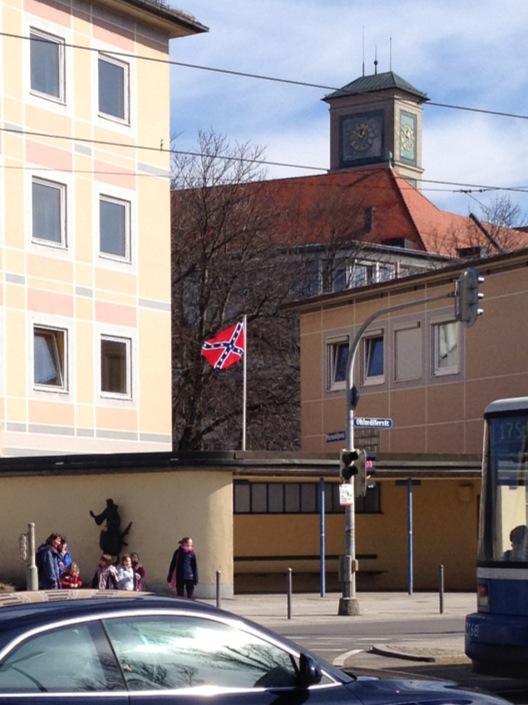 So I walked along Fraunhoferstraße which turns into Ohlmüllerstraße across the river on the way to the festival. It’s a pretty cool street. Record shops. Antique shops. Place to get what look like real dirndls. But why is there a Confederate Battle Flag?
Went in to the festival – a combination outdoor and indoor venue. First thing I did was went and got a maß (literally “measure” but use here for a liter) of Salvator, a schweinefleisch haxe (which is like a pigs knee or something) and a bretzel and dug in. The haxe was interesting – seasoned with rye an deep fried so the outside was crispy and tasted like a pork rind (which it is) but fairly dry inside despite being full of fat. Tasted great though.
When it started getting dark and cooling down I went inside the festhalle and accidentally sat next to 3 Americans who are here working at a hotel on a military base. They’re students studying hotel management at the University of Oklahoma. On my other side was a group of Germans. It was one of their birthdays. The guy would randomly look over and loudly sing “I’m proud to be an American! And I’m proud to know I’m free!” It was so funny I didn’t correct him but let him just go on butchering Lee Greenwood for hours.
 After a while of that we all split up an I headed up to near the front where the band was playing and where a lot of volks were singing and dancing. Every once in a while the band would strike up an English song like Country Roads and I would belt out the lyrics like the rest of them. I left as they were shutting the place down, having thoroughly exhausted myself on singing, dancing and drink. The event was definitely reminiscent of Oktoberfest and I guess most Bavarian beer fests would be the same.

Nuremberg; City of Brats and Beers
Nuremberg, or Nürnberg in German, is famous for their bratwurst. And rightly so. Several types of sausages are made in the Franconia region. And about 300 active breweries in the area! Gutmann Dunkel is a good one that you likely won’t find elsewhere. All the beers and wursts I tried were great.
 The Bratwurstkuche lays claim to the title of oldest bratwurst restaurant in the world! They’ve supposedly been serving up sausages here since before Columbus’ parents were even born. And though I’d suspect the place has been improved and rebuilt a time or two, it still seems pretty authentic – low ceilings, exposed beams, bricks and stone, etc. The famous dish here is the grilled version of their sausages that come with a pretzel and some potatoes or cabbage. It’s wonderful.
If you’re in need of an Internet fix when you arrive be sure to stop into the little Internet cafe in the main train station. From coffee to beer to wine to Jägermeister, they can quench your thirst. And you can sit all day on their Internet, unlike many cafes.
 All through St. Sebald church in Nürnberg are photos of the area before, during and after World War II. You can see how the place looked and how they rebuilt. Some poetry crudely translated from German adorns the placards. Some of it is funny. The place is certainly worth a look if you’re in the area.
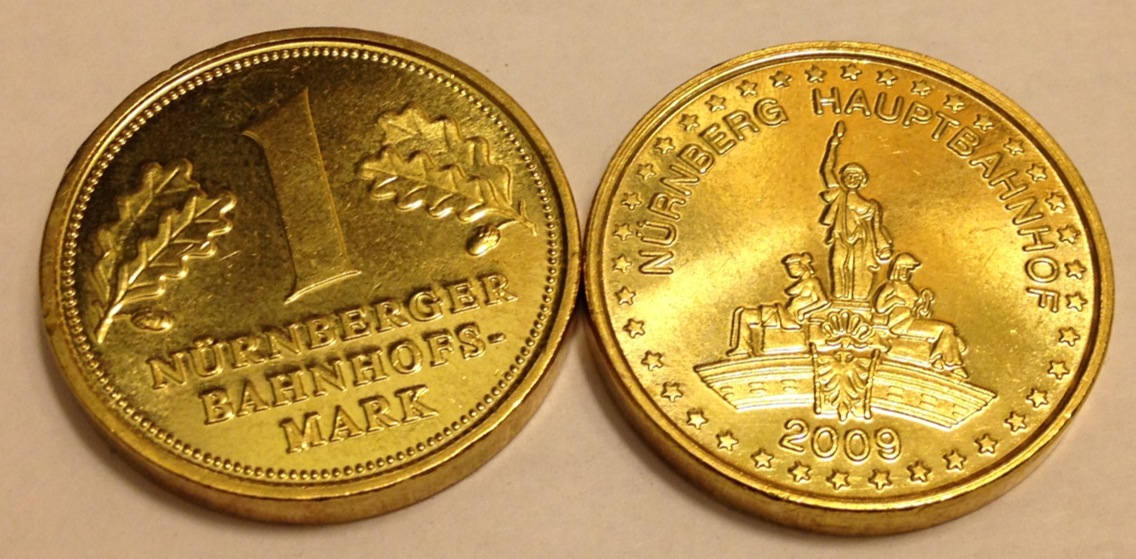
As I was on the way out of town I saw they had some kind of booth set up in the train station with a wheel of fortune and a line with people waiting to spin it. I had some time to kill so of course I decided to hop in line. When it was my turn I spun the wheel and it landed on 10. They gave me 10 little coins. I asked what they were for and they said it was good for 0.50 Euro each in spending at the train station. Cool!
Delayed at Borispol in Kiev
So there’s apparently a delay at Borispol airport in Kiev. Nobody at the airport seems to know why. But according to the Kyiv Post, the massive delays at Borispol were caused by an unpaid bill. According to the article, the billionaire oligarch who runs Ukraine’s largest airline failed to pay his airport bill for so long that they cut the airline off and shut down operations.
I can’t verify this, but I have some theories. First theory is that it was an honest mistake, the digital check got lost in the electronic mail, and that everything will be resolved quickly and amicably. Second theory is that someone on one side or the other is relatively incompetent and just didn’t do what they should have. Third theory is that this is a broader social issue around oligarchy in the region. Fourth is that this was a move to make money.
The official story is that there was a systems glitch. This caused payment not to be sent or applied. And everything would be straightened out quickly. But given that shutting off an airline would take a positive action on the part of someone, and that it would be guaranteed to cause massive disruption and frustration, it seems like it’d have to be a huge glitch that persisted over months with nobody’s common sense kicking in to fix it. Otherwise the organizations would work together to get it figured out and there would be no disruption. So that leaves us with one of the other two theories as being more likely.
What if some incompetent bureaucrat caused the shutdown? Given the region’s reputation for incompetent bureaucracies that seems like a likely candidate. Maybe the check or paperwork sat on somebody’s desk too long. Or maybe somebody went on vacation without approving whatever needed to be approved for continued service. Or somebody was just obstinate about process, paperwork or whatever and didn’t do the right thing by the passengers. That’s believable.
What if this were an oligarch fight? Aerosvit is owned by an oligarch, according to the article. But it’s not clear who owns and operates the airport. That may be another oligarch. So maybe this is a feud. Or maybe someone at the airport decided to stand up to an oligarch who refused to pay for services. Or maybe the airport was trying to squeeze the oligarch for more money or power or some other reason. That’s fairly likely as well.
But a complete shutout of Aerosvit isn’t exactly what happened. Instead, flights were coming in on time, but not allowed to leave for hours. So peasants passengers were forced to spend extra time inside the airport itself, not just backed up at other airports. And therefore they were more than likely to buy stuff – food, drinks, souvenirs, cigarettes, whatever. So really there was an economic incentive for the airport to keep people there longer than need be. Maybe not enough incentive to offset the loss of goodwill by the passengers and airline, but who knows. This would be just the thing to increase revenues in the short term – perhaps to pay for things like makeovers for security agents or ongoing expansions in advance of the European Cup?
 meanderingwoods